The recent delivery of the RDN’s new Quick Reference Recycling Guide in our mailboxes got the Habitat Restoration Committee thinking more about disposal of invasive plants. Common questions that Gabriola residents ask the committee include, “Can I put invasive plants in the RDN organics cart?” and “What options for invasive disposal are available?”
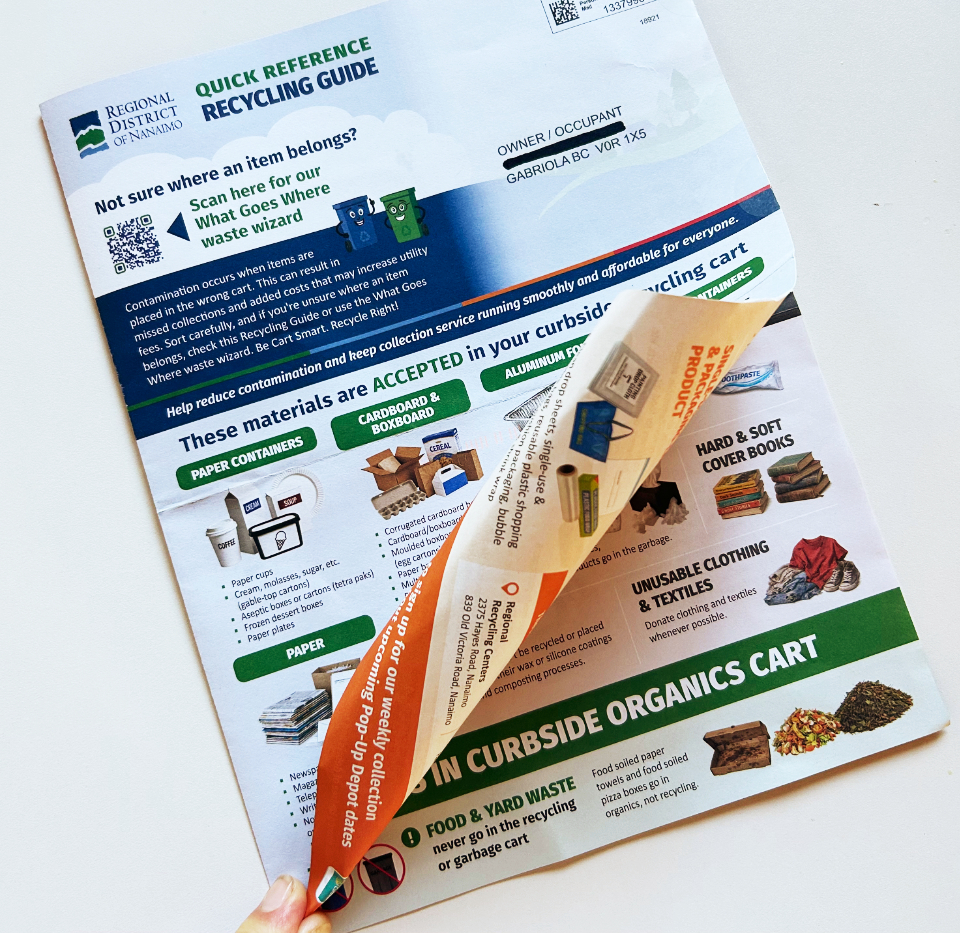
To help answer these questions, we rely on information provided by the RDN, such as their website, publications, and online tools. Unfortunately, the new guide does not tell us much about what is accepted in the organics cart. To find out what invasives are accepted, we did some digging on the RDN website and found – somewhat buried in the FAQ section of the Curbside Expanded Organics Program – a list of eight “priority invasive plants” that cannot be put into the organics cart:
- Giant hogweed (Heracleum mantegazzianum)
- Invasive knotweeds (Fallopia x / Polygonum polystachum)
- Garlic mustard (Alliaria petiolata)
- Spotted knapweed (Centaurea maculosa)
- Wild chervil (Anthriscus sylvestris)
- Poison hemlock (Conium maculatum)
- Gorse (Ulex europaeus)
- Daphne (Daphne laureola)
To find out how to dispose of these priority invasive plants, we checked out the newly updated RDN What Goes Where waste wizard, which is an online tool that explains how to recycle or dispose over 900 searchable items. A keyword search of “invasive plants” using the tool indicates that high-risk invasive plants must be double-bagged and disposed of at the regional landfill. Important: GaLTT strongly recommends that you seek advice on safe removal and disposal of toxic invasives such as giant hogweed, poison hemlock, and daphne before handling them.
Disposal of invasives on Gabriola is an ongoing problem, as there’s no simple on-island solution. GaLTT and GVFD have held drop-off events, albeit infrequent and with restrictions. Sometimes, onsite disposal is an option for some species, such as daphne and broom, which can be left on site (without seeds/berries) to decompose naturally. For additional information on disposal of invasive plant materials, visit the contact hrc@galtt.ca.
